Battle of Pitreavie
Article written by: Bob Swainson - The City of Dunfermline Heritage Group
July 20th 2026 marks the 375th anniversary of the "Battle of Pitreavie" of July 20th 1651. The Battle was fought between an English army and a Scottish army during the Anglo - Scottish War of 1650 to 1652.
Why did the Battle occur?
In 1642 the First English Civil War started due to political and religious differences between the King and Parliament, and lasted from 1642 to 1646.
The War ended with the Royalists defeated and the King in custody. Because Charles would still not concede power to Parliament, this sparked the Second Civil War from February 1648 to August 1648. In 1649 Charles I was executed and Cromwell declared England to be a Commonwealth, effectively a Republic. In 1650 Charles Il landed in Scotland, was proclaimed King of Scotland and Great Britain, and prepared to raise an army to invade England and regain the throne, a situation that Cromwell could not tolerate.
Thus the scene was set for the Anglo - Scottish War of 1650 to 1652. Cromwell crossed the border at Berwick on 22nd July 1650. He captured Edinburgh Castle on 24th December. However by July 1651 he couldn't get any further than Stirling because a large Scottish army had taken a defensive position there. To overcome this he decided to land upstream and attack Stirling from the east. He chose to sail an army from South Queensferry to Inverkeithing to achieve this. From 17th July to 19th July the English, through a series of landings at Crook Ness Inverkeithing, using specially built flat bottomed boats had landed an army of 6000 men.
By 20th July the English army were "dug in" on Ferryhills facing north. This was an army of around 6000 men of Cromwell's Army, well trained, well equipped, experienced soldiers, led by an experienced Commander Lambert. The Scots reacted to this threat by sending a force of 4000 men commanded by Major General Holborne, 3000 from the army at Stirling plus 1000 militia from Dunfermline. Unlike Lambert's troops the Scots were a mixed bag of volunteers and regular soldiers. Cavalry, foot soldiers and archers. Holborne's men formed at Castlandhill facing the English position.
The Battle itself was a short and bloody affair. There was some skirmishing and manoeuvring by the respective cavalry, and movement of Scottish foot soldiers towards the English. However, at some point the English cavalry charged and their infantry advanced causing the Scots to hastily withdraw. The withdrawal turned into a rout and the Scots retreated in a north west direction pursued by the English.
The Scots arrived at Pitreavie Castle hoping to gain sanctuary, this was refused by the owners, the Wardlaws, and even worse they threw stones down onto the Scots who were left to the mercy of the English, unfortunately mercy was in short supply. The Scots made a stand. At the end of the Battle it was estimated that the Scots lost 1600 dead, 1200 taken prisoner.
The Scots had made a heroic if futile stand and there must have been many unrecorded instances of heroism. However, there was one which was recorded and probably represents the heroism of them all.
Apparently 800 men of the Clan Maclean died where they stood, including their chief Sir
Hector Maclean, eight of the clansmen were successively killed protecting the chief shouting "Another for Hector" as each man threw himself between Hector and the English.
So, if the Battle is to be remembered it should be a tribute to the bravery of all those men who perished.
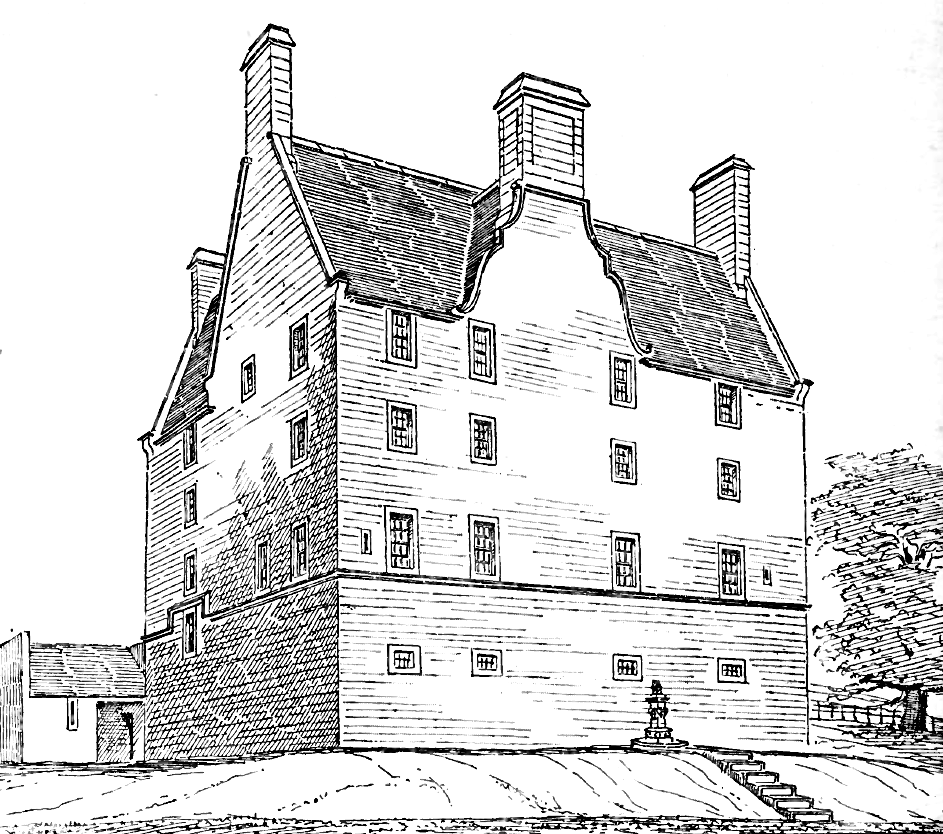
Photo Credit: Wikipedia
Pitreavie Castle, near Dunfermline, Fife, Scotland. The 17th century south front drawn in the 19th century, prior to the remodelling of the house in 1885.
By David MacGibbon and Thomas Ross - Macgibbon and Ross, Castellated and Domestic Architecture of Scotland Vol.2, p.537