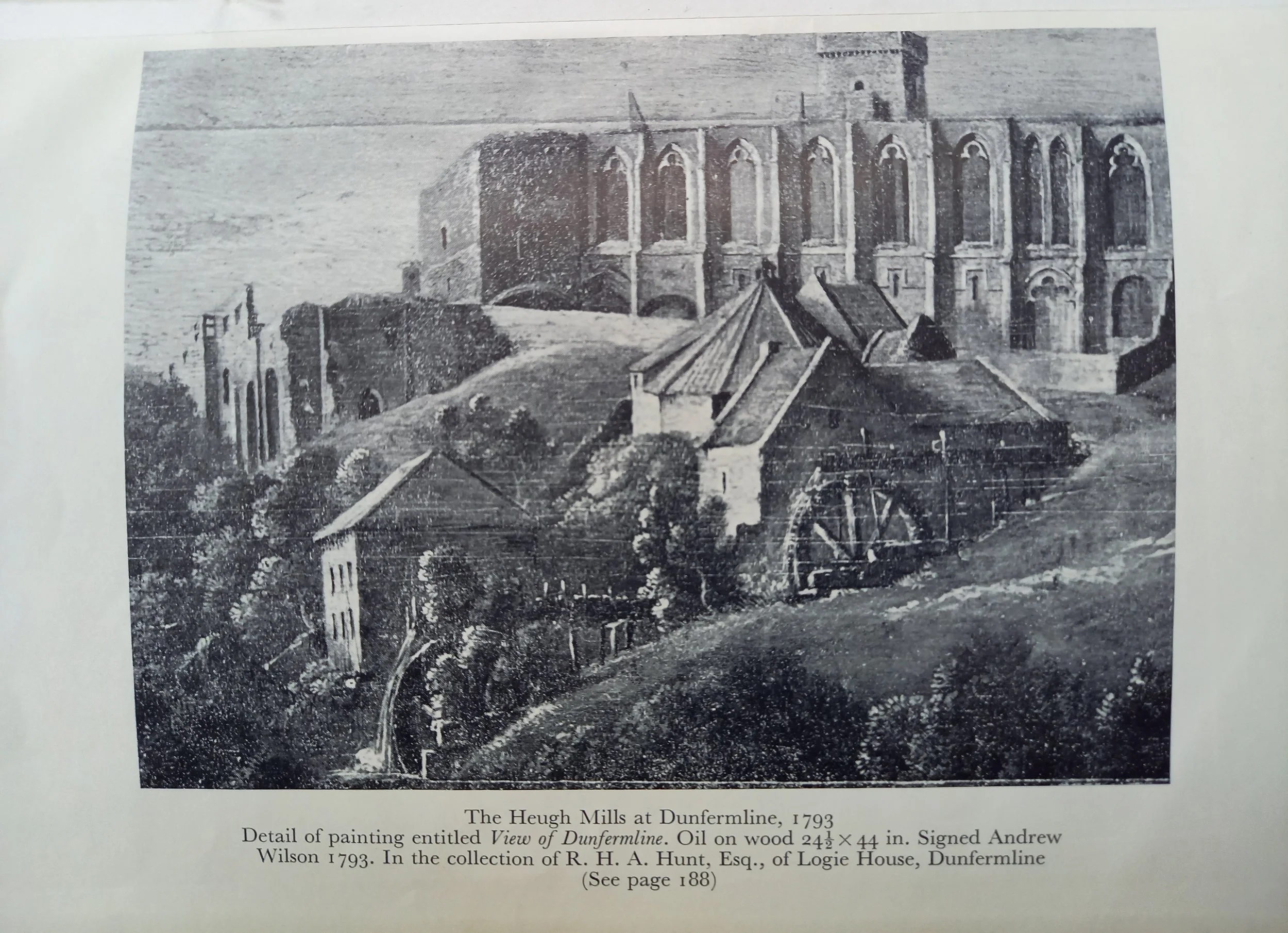
History of The Heugh Mills
Article written by: Bob Swainson - The City of Dunfermline Heritage Group
If you walk down Monastery Street to the WW1 War Memorial you will be in a place of peace and tranquillity, far removed from the hive of activity that defined the area in the 18th and 19th centuries, this activity was due to the location of the Heugh Mills.
Where were the Mills? If you go to the extreme right hand side of the Memorial and look over the wall or railings there you will see a steep slope into the Glen, the Heugh Mills were sited on this slope. Heugh is a Scottish word for a ravine or precipice.
Why were they there?
They were there because they were water driven mills, the water which drove them emerged from a tunnel approximately fifty feet below where you are standing and is still in evidence. The water came from the Mill Dam, a reservoir where Tesco is now, the water ran in a flagstone covered channel down Bruce Street, continued down the Kirkgate, turned right into the Maygate, left at the Library into the Abbey grounds, under Monastery Street, flowing out at previously mentioned tunnel. The water then ran in wooden troughs to the mill wheels, the wheels were 'overshot', meaning that the water met the wheel at the top of the wheel, when the mill was not in use the trough could be turned away from the wheel and the water would flow into the Tower Burn. The water used to turn the wheels also flowed into the Tower Burn.
According to historical accounts watermills were in operation on the Heugh site from 1374 until 1819.
1374 - Henderson's 'Annals of Dunfermline' mentions the Abbey Mill in Monastery Street
1518 - the 'Regality of Dunfermline Court Book' records that a Thomas Fyne was the Miller of the Heugh Mills, there were two mills at this time
1580 - the 'Regality of Dunfermline Court Book' records that a James Murray of Perdew obtained the two Heugh Mills from Master John Pitcairn
1628 - Shearer's 'Dunfermline Burgh Records' has a record of a John Smart delivering malt to a Laurence Anderson to be ground at the Heugh Mills
The eighteenth century was probably the busiest time for the Mills.
1733 - The Town Council agreed that a wheat mill be built for the 'Corporation of Bakers'
1772 - Thomas Pennant mentioned on his 'A Tour of Scotland,' that there were five Mills, three corn mills, one flax mill and a mill for beating iron
1784 - Flour Mill was built, this was the most important mill of this time, apparently the only flour mill in Dunfermline
1819 - A steam engine was installed in the Flour Mill to maintain production, the average annual production was 7194 bolls( 1 boll estimated to be equal to 140 pounds), therefore average annual production was 1,007,160 pounds of flour
By 1859 there appears to be only three mills referred to by Chalmers in his history of the town - Flour mill, Meal mill and Snuff mill
The Mills ceased production towards the end of the nineteenth century, and the buildings were partially destroyed in 1909 to accommodate expansion of the Glen.
Next time you walk down Monastery Street from the Pends to St Margaret Street you may be able to envisage the activity and industry that once defined the area.